

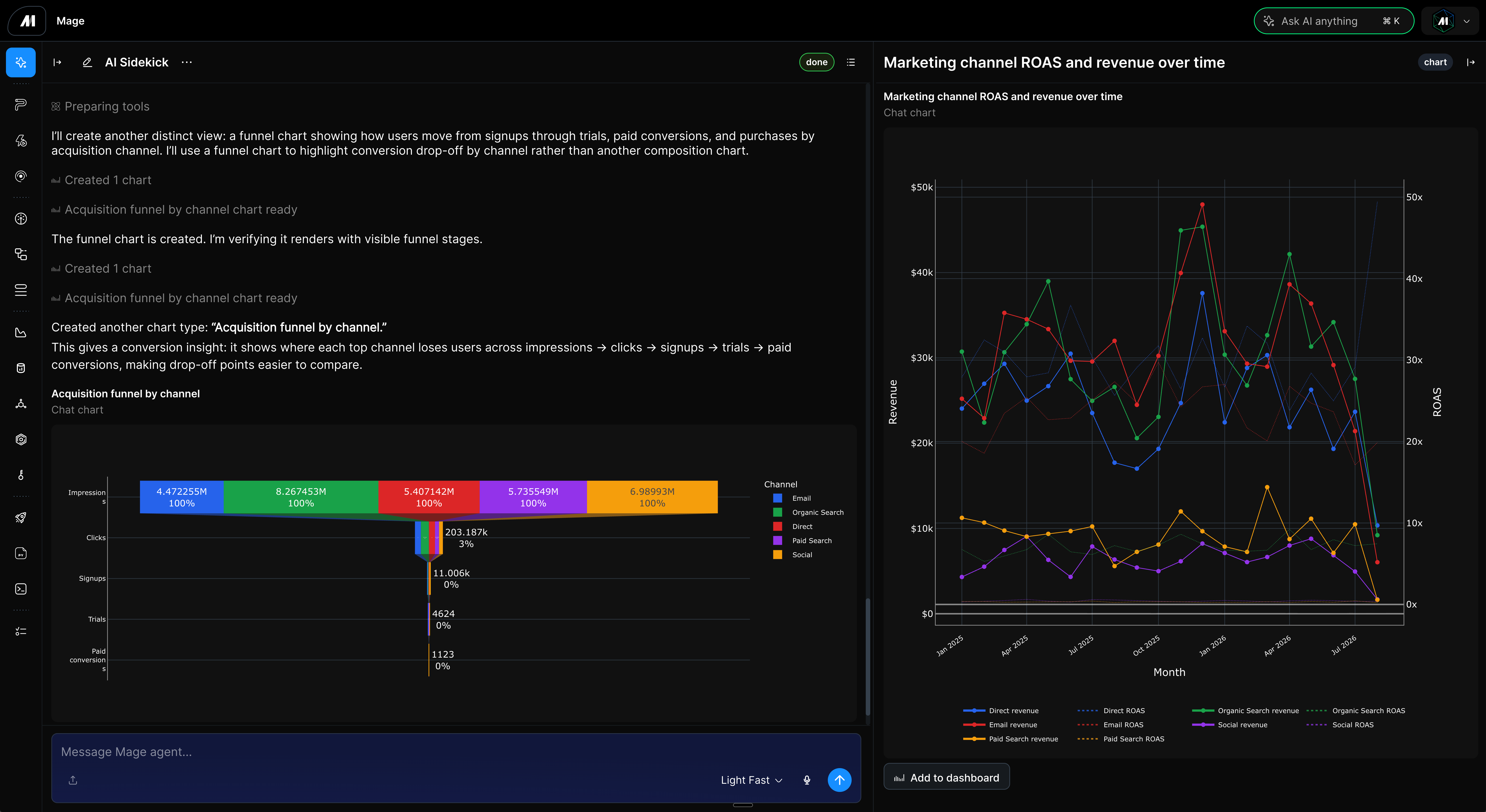
How to Access AI Sidekick
AI Sidekick is available in Mage Pro wherever contextual help or automation is most useful.- Open a Mage Pro workspace.
- Open a pipeline, block, run, Analytics page, data preview, or code page.
- Click the AI Sidekick entry point in the page header, right panel, output toolbar, chart workflow, or contextual action menu.
- Ask in plain English, choose a suggested prompt, or attach the current page, file, block output, chart, or data preview as context.
How to Use It
Start with the outcome you want, not the implementation details.What AI Sidekick Can Do
Build Pipelines from a Prompt
Describe the data workflow you want and Sidekick can create the pipeline, choose the right block types, generate block code, wire dependencies, apply templates, and set up the supporting configuration. It can work with batch pipelines, streaming pipelines, integration pipelines, dbt workflows, dynamic blocks, callbacks, conditionals, sensors, charts, global data products, and custom project code. Examples:- “Build a daily customer health pipeline from HubSpot, Stripe, and Snowflake.”
- “Add a dbt model step after this loader and run only the selected model.”
- “Create a streaming pipeline for Kafka events and write clean records to S3.”
- “Split this block into dynamic children by country, then reduce the results.”
Generate, Edit, and Repair Blocks
Sidekick can create blocks, update existing logic, refactor code, explain what a block does, change dependencies, and keep block metadata aligned with the pipeline. It understands common Mage block languages and patterns, including Python, SQL, R, YAML, Markdown, dbt, and data integration templates. Use it for everyday engineering work:- turn a plain-language transform into reusable code
- add retries, timeouts, variables, secrets, or execution settings
- convert exploratory code into production-ready blocks
- update upstream or downstream dependencies
- fix syntax errors, runtime exceptions, and broken imports
- preserve the current editor context while applying file-backed updates
Debug Runs and Self-Heal Failures
When a pipeline run fails, Sidekick can inspect the run, block statuses, logs, outputs, and recent changes, then explain what happened in terms a data team can act on. If you ask it to fix the problem, it can update the broken code and retry the failed or incomplete work on the original run instead of creating a separate run with different context. Examples:- “Why did this run fail?”
- “Fix the failed block and retry the downstream blocks.”
- “Summarize all ERROR logs for the last three runs.”
- “Find the schema change that caused this exporter to break.”
Explore Data in Chat
Sidekick can discover authorized data sources and pipeline outputs, inspect schemas, ask for missing warehouse, database, schema, dataset, table, or catalog selection, and open a windowed data preview directly in chat. For SQL-capable sources, it can create read-only query previews for grouped results, joins, derived columns, filters, and comparisons. The preview stays interactive. You can sort, filter, select columns, ask follow-up questions, return to a parent preview, or branch into another refinement without copying a full dataset into the conversation. Examples:- “Show revenue by month from the warehouse.”
- “Only include enterprise accounts and sort by ARR descending.”
- “Compare this block output against yesterday’s run.”
- “Count rows by status, then open the result as a table.”
Create Analytics and Data Products
Sidekick can turn pipeline outputs, data previews, SQL results, and existing charts into Analytics assets. It can generate Plotly code, create chart metadata, save bounded chart-ready datasets, attach charts to the right dashboard, and refresh the open Analytics page after the chart is saved. Ask for:- operational dashboards from pipeline outputs
- revenue, usage, churn, or conversion charts from warehouse data
- chart edits such as new filters, titles, colors, or grouping
- table-backed data products for analysts and stakeholders
- chart explanations for people who did not build the pipeline
Understand the Page You Are On
Sidekick can answer page-relative questions such as “what am I looking at?”, “why is this empty?”, “what changed here?”, or “what should I do next?” because Mage passes it scoped page context for the active chat turn. It can also use recent interaction context, selected text, current file context, active preview context, and chart workflow attachments when those are available.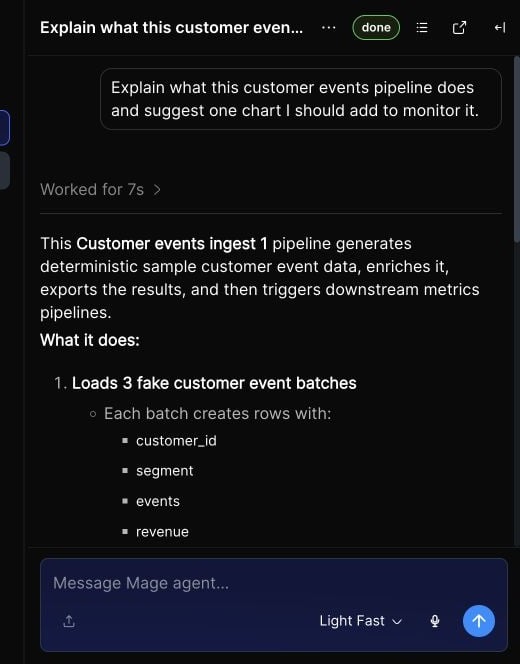
- explain a pipeline graph to a new teammate
- summarize the selected code in Apps Coder
- describe why a chart or preview is filtered
- compare what the UI shows with the last successful run
- keep an Analytics edit focused on the selected chart
Search Docs, Project Knowledge, and Chat History
Sidekick can search Mage documentation, read relevant pages, inspect project instructions when they matter, and use previous chat turns or tool outputs to continue work without making you repeat context. When retrieval is enabled for a project, it can reference the project files, configuration, docs, and code that you permit it to read. Use this for:- “How should I configure this trigger?”
- “Find the docs for dynamic blocks and apply the pattern here.”
- “Continue from the chart we created earlier.”
- “Read the last tool output and explain why it failed.”
Operate Production Workflows
Sidekick can help with the operational surfaces around pipelines: schedules, triggers, backfills, runs, jobs, block runs, outputs, logs, variables, secrets, notifications, permissions, users, roles, deployments, compute, Spark, global hooks, version control, and workspace settings. It can list, inspect, create, or update supported Mage resources through the same authenticated Mage APIs that power the product. Examples:- “Create a weekday trigger for this pipeline with these runtime variables.”
- “Backfill this pipeline for the last seven days.”
- “Show active triggers and the next run time for each.”
- “Check whether this user has permission to view the workspace.”
- “Review Spark executor status for the slow run.”
Work with Files and Versioned Project Code
Sidekick can read and update project files, upload or download supported files, record changes so Mage file versions stay accurate, inspect file history, and coordinate code changes with pipeline or block metadata updates. It can also use sync workflows when local and remote project files need to be reconciled. Use it when you want to:- update a utility module used by multiple blocks
- change a YAML config and apply the related Mage metadata update
- inspect file versions before accepting a change
- create a new project file from a prompt
- pull or push project changes through an agent workflow
Coordinate Longer AI Workflows
For larger requests, Sidekick can break work into smaller AI tasks, wait for results, cancel stale work, and summarize progress back into the main chat. This is useful for independent review, broad discovery, test-gap analysis, migration work, or multi-step implementation where several pieces can be investigated at the same time. Examples:- “Audit these five pipelines and summarize the risky patterns.”
- “Have one agent inspect docs and another inspect code before proposing a fix.”
- “Generate a migration plan and check the source project inventory.”
- “Run an independent review of the changes before I ship them.”
Generate and Understand Media
In Sidekick sessions that enable media tools, Sidekick can transcribe audio, translate audio to English, create spoken audio from text, generate images, edit images, and create or download short videos. Generated files are saved to the Sidekick media area for the active chat and are returned through authenticated preview links. Use this for:- transcribing a stakeholder recording into requirements
- generating a narrated explanation of a pipeline result
- drafting images for reports, demos, or internal docs
- editing chart screenshots or data-product visuals
- producing short demo clips from a written prompt